In a December 15 post, I mentioned the recent one-vote annexation referendum in Knox County.
More on the November referendum here.
The sole voter in the referendum, 20-year old Garrett Meek, can't be reached for comment.
Meek worked for a subcontractor on the annexation site, moved into a house on the site in March 2006, and registered to vote in Knox County.
Shortly after Meek cast the deciding and only vote in the Knox County annexation referendum, the house he had lived in was demolished.
The referendum has some commissioners and others concerned about the process and asking questions about whether "the single voter, a young man who did not own property within the annexed area, was a qualified voter..."
There are also those who want the state to investigate whether the Knox County Election Commission placed the question on a sample ballot as required by state law; whether the election commission gave proper notice of the referendum; and whether the notice was adequate and included necessary exhibits, including a map of the area to be annexed.
The Knox County Election Commission says everything was OK legally.
Mayor Mike Ragsdale, the City, and the developer want everyone to focus on the property and sales tax money that the project will bring in.
The development will bring in money.
The questions that are being asked, however, are not about how much money the project will bring in but are about conduct of an election with proper notice, sample ballots, maps, and a qualified voter.
Only time will tell whether there will be an answer to those questions.
Monday, December 18, 2006


Saturday, December 16, 2006
December 15, 2006 Mama Bird "Evelyn Bryan Johnson" Hall of Famer
She is a legend in Morristown and elsewhere.
At 97, she is going to be inducted into the National Aviation Hall of Fame.
She is Evelyn Bryan Johnson who took up flying in 1944 and started teaching others in 1947.
The Tennessean already has the story here.
What an accomplishment for a lady known as "Mama Bird"!
Friday, December 15, 2006
December 15, 2006 One-Man One-Vote One-Annexation
A little-advertised annexation referendum took place in Knox County recently.
There was only one eligible voter. He showed up at the polls and voted in favor of annexation.
With his sole approval, seventy acres in south Knoxville were annexed into the City of Knoxville.
A Lowe's Home Improvement store is on the site, and restaurants and other businesses are expected to follow now that the annexation is complete.
Who was the lone voter? A man who worked for a subcontractor on the site, who lived on the site, and whose "home" was demolished after the referendum.
Who says one vote doesn't count?
December 14, 2006 Chancellor: New Supreme Court Nominee Must Be Named
It is taking a long time to fill a vacancy on the Tennessee Supreme Court.
Chancellor Ellen Hobbs Lyle of Nashville has ruled that the Judicial Selection Commission must provide Governor Bredesen with another name to complete a 3-name "second panel" from which the Governor will select a Supreme Court nominee.
The story is here.
It is a complicated situation. Many months ago, the Judicial Selection Commission provided the Governor with 3 names ("first panel") from which to select the next Supreme Court nominee.
One of the three candidates, the only minority nominee, asked to withdraw for personal reasons. At that point, the Governor rejected the "first panel" completely because it no longer had a minority candidate.
The Judicial Commission then came back with a "second panel," but the "second panel" included one of the individuals who had been on the "first panel."
In Lyle's opinion, the state law is clear — the second panel must have three candidates, each of them different from the first panel.
Gordon’s attorney, Charles Bone, sees it differently and hinted that an appeal may be filed.
Bone said: "We anticipated from the beginning that this matter would ultimately be resolved by the Tennessee Supreme Court. I anticipate one or more of the parties will file an appeal."
Thursday, December 14, 2006
December 14, 2006 And the Answer Is....

With lots of local and state news lately, the Tennessee Trivia Question of December 8 just about got forgotten.
The Question: What was the first TVA dam constructed?
The Answer: Norris Dam
More facts:
Norris Dam was named for Nebraska Senator George Norris who authored the federal legislation creating TVA.
Construction on Norris Dam began in 1933. Norris Dam is on the Clinch River. The first production of electricity occurred in 1936.
TVA has more info here.
Wednesday, December 13, 2006
December 13, 2006 Edmund Ford Talks about Big Loans from Friends
Memphis is a city in a mess.
Indicted Memphis City Councilman Edmund Ford is still denying taking bribes. Instead, he explains that he is the fortunate recipient of very generous loans from developer friends.
Although Ford has declared bankruptcy several times, he has wealthy real estate developer "friends" who want to loan him money.
And to hear him tell it, the $40,000 loan from a developer friend to help him build his mortuary and the $50,000 loan from a developer friend to help purchase a Cadillac SUV have never influenced his vote on planning or zoning issues that come before the Council where these "friends" are involved.
The full story is here.
Developers make loans to an elected official who has no credit, who has to get someone else to co-sign a car loan, and who has declared bankruptcy numerous times. Why?
A recent letter to the editor in the Commercial Appeal from a city employee included this statement about the loans:
...I drive a 10-year-old Honda Accord that does the job just fine. I don't see Cooper or Rusty Hyneman lining up to co-sign and pay for my new Caddy, and I am a city employee whose job is just as important to our future as (Edmund) Ford's. It's just not profitable for Hyneman or Cooper, like unnecessary development and cars for drug dealers apparently are...
December 13, 2006 State Ethics Committee: Attorney-Client Privilege?
In a really strange twist of fate, the ethics and legality of actions of the Tennessee Ethics Commission are being questioned.
The Commission was recently asked to provide an "advisory opinion" to two Nashville lawyers who wanted to know when the duties of a lawyer require him or her to register as a lobbyist.
The commission is required by law to answer such questions in order to help lobbyists and public officials avoid conflicts and ethical violations.
The News-Sentinel article is here.
How the Commission handled the request is at issue.
The Tennessee Bar Association (TBA) alleges that staff and members of the Ethics Commission prepared and circulated drafts and e-mail comments of the proposed advisory opinion but did not make the drafts or e-mails public.
Allan Ramsaur, head of the TBA, maintains that these exchanges and comments violate Tennessee's open meetings law requiring governmental bodies to hold all discussions and deliberations in an open, public meeting.
The commission, according to Ramsaur, was debating, discussing, and commenting on the issue in secret via e-mail exchanges.
Ethics Commission Chairman Tom Garland did not believe there was a violation. But, if there was a violation, it was "insignificant."
Then there are additional allegations that the Commission violated Tennessee's Open Records laws. An attorney, Courtney Pearre, filed a public documents request asking that all drafts and related documents be provided.
The state's "open records" law requires that most documents created, sent, or received by government agencies - with some exceptions - be made public upon request.
The Commission refused Pearre's initial request but is still "considering" the matter as it seeks guidance from the state attorney general's office.
The Executive Director of the Ethics Commission, Bruce Androphy, cites the "attorney-client privilege" and "the deliberative process privilege" as exceptions to the requirement that records be made public.
Androphy adds that the commission believes that the draft documents and e-mails requested by Pearre are covered by one or both of the privileges.
Ramsaur, head of the Tennessee Bar Assn., responded that the "deliberative process" exception - keeping draft documents secret when in draft stage - is not recognized in Tennessee and that the "attorney-client" privilege apparently does not apply.
Frank Gibson, executive director of the Tennessee Coalition on Open Government, apparently agrees with Ramsaur that the draft documents are not protected by any privilege and are public documents.
On a possible violation of Tennessee's Open Meetings Law, Gibson adds that this would depend on the content of the drafts and the e-mail comments and whether the drafts and e-mails show that "deliberation" was taking place.
Tuesday, December 12, 2006
December 12, 2006 Ethics Policy in Hamblen County
The Hamblen County Mayor had the CTAS (County Technical Assistance Services) Model Ethics Policy on the agenda for County Commission Committee meetings yesterday.
My December 10th post provided information on the Model Policy and a link where the entire policy can be reviewed.
County Attorney Rusty Cantwell suggested that action on the policy be postponed until the January meetings to allow more time for review. The committee agreed to wait and give all commissioners more time to look at the policy instead of taking a vote yesterday.
The Model Policy is a lengthy document. There should be a great deal of discussion and a lot of questions from commissioners and others because the policy will have an impact on commissioners, other elected officials, county employees, and members of county boards and agencies.
State law mandates that a county policy be in place by June 30, 2007.
The adoption of a Hamblen County Ethics Policy could be one of the most important actions that the current county commission undertakes. Here's hoping that there will be lots of questions, answers to those questions, and open and frank discussion about any new ethics policy.
As I have mentioned before, there are numerous conflicts of interest in both city and county government. Because Tennessee's conflict of interest laws are so wide that you can drive a truck through them, the local conflicts may or may not rise to the level of "legal" conflicts.
Despite the weakness of conflict on interest laws, the average person who works for a living easily sees everyday conflicts of interest when he observes elected and appointed officials hiring and supervising their own relatives, voting on budgets and appropriations that affect a spouse or child, serving on inter-related boards and commissions, and collecting two or three checks from the county and county boards and agencies.
There is a great opportunity now for the Hamblen County Commission to rise above partisanship and self-interest and to set the ethics bar at the highest level in Hamblen County.
Hopefully, commissioners will seize this opportunity and adopt a stringent ethics policy with the highest standards.
Wouldn't it be great to see articles across the state noting that Hamblen County adopted the most demanding ethics policy of any county?
If there's any area where it is clearly important to be #1, it would be in the adoption of an ethics policy that exemplifies the highest in governmental integrity and that demands that elected officials and governmental employees avoid even the appearance of impropriety in their actions!
Monday, December 11, 2006
December 10, 2006 A New Local Ethics Policy
The General Assembly passed the "Comprehensive Governmental Ethics Reform Act of 2006" in February of 2006. T.C.A. § 8-17-101 et seq.
The Ethics Reform Act requires local governments to adopt ethical standards related to the acceptance of gifts and disclosure of conflicts of interest. It also directs CTAS (County Technical Assistance Services) to develop a Model Policy.
Counties must adopt an ethics policy by June 30, 2007.
The policy must address at least two things: (1) disclosure and/or limits on gifts and (2) disclosure of conflicts of interest.
The policy applies broadly to all officials and employees and members of all boards and commissions of a county.
The CTAS Model Policy can be adopted as is or with modifications. The entire Model Policy can be seen here.
Here are a just few abbreviated highlights.
Section 1: The definition of "County" is broad.
The definition of "officials and employees" who are covered by the policy includes elected and appointed county officials, county employees, and members of county boards, agencies, etc.
The Ethics Reform Act mandates disclosure of personal interests that impact or appear to impact the discretion of officials and employees.
A personal interest that must be disclosed is a financial interest of the official or employee or a financial interest of a spouse or child who lives in the same household with the official or employee.
Section 2. Conflicts of interest. A person whose duty it is to vote on county matters must publicly disclose any personal interest that they may have in a matter to be voted upon if that personal interest affects the person’s vote or if it would lead a reasonable person to believe it affects the person’s vote.
Section 3. Matters where a vote is not involved but which require the exercise of discretion. Officials and employees must publicly disclose any personal interest that affects or would lead a reasonable person to believe it affects the person’s exercise of discretion even when there is no vote.
Section 4. Prohibition from accepting gifts by employees and officials.
Section 5. Creation of a five-member County Ethics Committee to receive and investigate complaints of violations of the policy and to refer matters to the appropriate person or agency for further action, if appropriate.
**The Ethics Reform Act does not contain any provisions regarding a local Ethics Committee or enforcement of the ethical standards or specific penalties.
Although the state act does not require an Ethics Committee, the CTAS Model Policy does include creation of such a committee to receive complaints in section 5.
In Hamblen County, there is a commissioner who is a county employee, there are commissioners who serve on multiple boards and agencies, and there are commissioners who vote on budgets and appropriations that financially affect their spouse or other relative.
County Attorney Rusty Cantwell will be the key. If he decides that current commissioners do not have financial interests that create conflicts of interest, then the Model Policy might be adopted as is.
If, however, he decides that the wording of the Model Policy might affect certain current county commissioners due to conflicts and various personal financial interests, you might see county commission asking Mr. Cantwell to make changes that would remove commissioners' conflicts of interest by simply re-defining the term.
Add a few words, remove a few words.
Poof! No more conflicts of interest on county commission or anywhere else!
Saturday, December 09, 2006
December 9, 2006 Bredesen: Brunson Selected as New Dep. Governor
Gov. Bredesen has selected Stuart Brunson, manager of Bredesen's 2002 and 2006 gubernatorial campaigns, as his new Deputy Governor.
Brunson will be in charge of political and constituent concerns.
Brunson replaces former Dep. Governor Dave Cooley who recently resigned.
Friday, December 08, 2006
December 8, 2006 Edmund Ford: It Was a "Loan"
Last year's Tennessee Waltz sting operation resulted in the arrest of a handful of sitting Tennessee legislators and shocked the state.
Most legislators got on the ethics bandwagon, and the Tennessee General Assembly met in a special session and passed ethics legislation in early 2006.
The legislation was intended to rein in influence peddling, conflicts of interest, and bribery both at the state and local levels.
Sadly, Memphis (Shelby County) is in the midst of two new FBI operations--Main Street Sweeper and Clean Sweep.
These operations have resulted in the arrest of two sitting Memphis City Councilmen (Edmund Ford and Rickey Peete) and one former Shelby County Commissioner (Joe Cooper).
A December 2 post discusses the charges against Councilmen Rickey Peete and Edmund Ford.
Now, one of the accused, Edmund Ford, is talking about the money that he took. The Commercial-Appeal has the full story.
Ford has viewed the tape showing him taking money from FBI informant Joe Cooper. Ford says he "laughed" when he saw the tape.
According to Ford, the tape shows him taking a "loan" from Cooper so that he could catch up on financial obligations--one of those obligations being making payments on a Cadillac sport utility vehicle that he leases.
Reportedly, Cooper was a salesman at Bud Davis Cadillac last year when he arranged for Edmund Ford to lease a $50,000 Cadillac SRX.
Ford had bad credit and couldn't qualify for the car on his own, so a local millionaire developer, Rusty Hyneman, graciously co-signed the lease.
Ford says that Hyneman did not co-sign the note in order to influence Ford's votes on development issues. Ford says that Hyneman co-signed the note simply because he is a friend.
Ford also says that when he (Ford) fell behind on the lease payments, another person whom he thought was a friend (Joe Cooper, the former car salesman) lent him money.
Apparently, the FBI looks at the cash payments differently.
The FBI alleges that Ford took a total of $6,900 in three payments between Aug. 30 and Oct. 27, 2006. An affidavit from an FBI agent says that the money was in exchange for Ford's support and influence on a billboard development on I-240.
Now it will be up to a jury to decide whether Edmund Ford took a bribe or a loan.
December 8, 2006 Tennessee Trivia Question
The Tennessee Valley Authority has been in the news lately with its Board voting on a new land policy curbing the sale of TVA's public land to private developers.
Our Tennessee Trivia Question is about TVA:
What TVA dam was the first one built?
Send replies to noe4accountability@yahoo.com
Thursday, December 07, 2006
December 7, 2006 "A Date Which Will Live in Infamy"
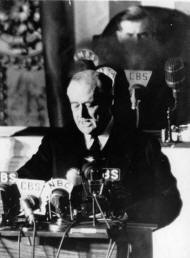 Pearl Harbor Day. December 7, 1941.
Sixty-five years have passed since the Japanese attack on the U. S. naval base at Pearl Harbor, Hawaii.
The actions of the Japanese on that day altered world history and spurred the United States to enter World War II.
Japanese Admiral Yamamoto has been widely quoted to have said after the attack, "I fear all we have done is to awaken a sleeping giant."
Indeed, the giant awoke with swift and firm resolve.
President Franklin Roosevelt (pictured) gave a stirring address to the U. S. Congress on December 8, 1941:
"Yesterday, December 7th, 1941 -- a date which will live in infamy -- the United States of America was suddenly and deliberately attacked by naval and air forces of the Empire of Japan."
Roosevelt's entire speech can be read and heard here. (www.Americanrhetoric.com)
It is magnficient.
Wednesday, December 06, 2006
December 6, 2006 Another Tennessee Waltz Conviction in Memphis
The Memphis Commercial-Appeal reports that Michael Hooks, Sr. was sentenced today to 2 years and 2 months in prison for accepting over $24,000 in bribes while serving as a Shelby County Commissioner.
Hooks' arrest was part of the FBI's Tennessee Waltz sting that resulted in numerous statewide arrests and convictions of elected officials, including several Tennessee legislators, a school board member, a county commissioner, and others.
Several of those who were arrested in the Waltz have already been tried and convicted. However, a few, the most prominent of whom is former Sen. John Ford of Memphis, have not had their day in court yet.
Hooks was filmed taking money in return for helping a fictitious company, "E-cycle," get government contracts and business in Shelby County.
Read the story here.
December 6, 2006 Passenger Evicted as Gas Causes Emergency Landing
Check out this link to a story in the Tennessean about an airline passenger whose "indigestion" caused an emergency landing of her flight.
The lady repeatedly lit matches on the plane, attempting to disguise the outwardly effects of her indigestion.
Sad to say, she was not allowed to get back on the flight.
The story, absent the passenger's eviction, is a gas!
Tuesday, December 05, 2006
December 5, 2006 Hamblen-Jefferson Financial Problems
The new Jefferson County Mayor Alan Palmieri made the front page of the Sunday newspaper expressing concerns about the fact that Jefferson County has been making interest-only payments on the county debt and shuffling money all around.
Hamblen County has been doing the very same thing---and more. See recent posts here and here.
Here are some bits and pieces of Palmieri's discussion of the type of financial sleight-of-hand that occurs when power is centralized, checks and balances are ignored, and no one asks and no one answers tough financial questions.
---------------------------------
Palmieri took office as county mayor Sept. 1, replacing Gary Holloway (sic) who had served in the office for 20 years. The issues, according to Palmieri, include the justice center which is $2 million over budget...
...the planning for the $14 million center did not take into consideration staffing and utilities issues. "Those issues should have been handled up front," he said.
Although the sheriff was told initially that the bond issue included funding for those areas, he now says "the money was spent for other things."
Palmieri points out that the county also is facing a school building project...
He says the cost of the school expansion project has ranged from $18 million to $70 million and "somehow we are going to have to deal with how we’ll fund that project and how soon we’ll get it off the ground."....
The county mayor will make a proposal for a 12-year plan to eliminate the county’s current $63 million debt, take care of the school building needs and develop an industrial park without raising the county property tax rate.
Palmieri is tight lipped about his financing plan or how much he will propose for the various needs of the county, but he is critical of the past practice of "making interest payments but no payments on the principal of the debt."
-----------------------------
Hamblen County? Same financial story, but no newspaper articles.
There won't be a front-page story with the truth from an elected official or from an investigative reporter about what's going on here.
There won't be a picture of the County Mayor and an article where he expresses concern about years and years of interest-only payments and switching money around.
There won't be a story where the paper or commissioners ask questions and report the Hamblen County Mayor's role and actions in bypassing county commission in making an appropriation of money.
The Mayor just takes a county matching funds spending resolution, signs it, has his employee sign it, and then sends it to the state along with a letter falsely telling the state that the matching funds resolution he signed was voted on and approved by the commission.
Who needs a commission to make an appropriation of money as required by law when the Mayor just signs, seals, and delivers it without bothering to get a vote?
There won't be a story where the Hamblen County Mayor is asked to explain why he enrolled the director of one local non-profit organization, his close personal and political friend, on the county's insurance but didn't offer the same enrollment/payment deal to other non-profit directors.
No questions about whether it was legal to put the friend on in the first place. No questions about, if it was legal, why weren't other non-profits given the same opportunity?
The 11-year shell game has gone ka-put. Now what?
Where is the man or woman on commission--or anywhere else--who is prepared to insist that the Mayor answer truthfully to allegations of falsifying documents, putting friends on the county insurance, and shifting money around without authorization?
Where is the man or woman on commission--or anywhere else--who is prepared to publicly say that such actions, if true, show abuse of office and contempt for our system of checks and balances?
Where is the man or woman on commission--or anywhere else--who will start to ask questions and really watch the county's finances closely.
A newly-elected official in Jefferson County is opening up the information pipeline, admitting problems, and using common sense to address the issues.
Anything less than that in Hamblen County, and you're just rearranging the chairs on the deck of the Titanic.
Monday, December 04, 2006
December 4, 2006 Tribune Article on Jefferson County Finances
Economic realities and financial problems in Jefferson County made the front page of the Citizen-Tribune yesterday.
Jefferson County Mayor Alan Palmieri has called for a special meeting of the Jefferson County Commission today.
Palmieri apparently plans to tell the Jefferson County Commission about years and years of piling up debt and then making interest-only payments on that debt, shuffling money around, and no planning.
These financial practices seem to have placed the county in a bad situation---especially with justice center funding and another school building program just around the corner.
Now what will the members of the Jefferson County Commission say and do?
Who was asking questions during the years of these interest-only payments? Were Commissioners checking to see that money went where it was supposed to or did they just blindly trust someone else to spend the money like it was supposed to be spent?
For a moment as I read the story, I thought I was reading about Hamblen County because my recent posts here and here report the very same financially disastrous activities: interest-only payments, switching money around, no planning, and little accountability.
Unwise financial practices are now coming home to roost in Jefferson and Hamblen counties. In Hamblen, the problems are the result of a lack of checks and balances, a huge fear of asking questions, and a lack of openness and truthfulness.
And the taxpayers are in for a world of hurt.
When elected officials find themselves doing favors and providing cover for themselves and for one another instead of serving the people and being honest, the stink eventually comes out.
The full Tribune article on Jefferson County can be found here. Since the link may or may not work in the future, I'll provide a fuller report later.
Saturday, December 02, 2006
December 2, 2006 Public Corruption Arrests in Memphis
Shelby County /Memphis government officials have made the news again with more indictments for bribery.
Just a year or so after federal prosecutors issued Tennessee Waltz indictments against several Shelby County/Memphis officials, the most prominent of whom was State Sen. John Ford, operation "Main Street Sweeper" has resulted in bribery charges against two Memphis City Councilmen.
The indicted Memphis City Councilmen are Rickey Peete and Edmund Ford.
Does the second name have a familiar political ring?
Edmund Ford is former State Senator John Ford's brother. He is also Harold Ford, Sr.'s brother and Harold Ford Jr.'s uncle.
The mythical and powerful Ford machine now has the dubious distinction of having a family member indicted in the "Tennessee Waltz" scandal (John) and in the "Main Street Sweeper" scandal (Edmund).
In a separate investigation dubbed "Clean Sweep," former Shelby County Commissioner Joe Cooper was indicted for money laundering.
A news video about the arrests can be seen on Memphis TV. Click here for the video site. Then scroll down on the video list to the right of the media player screen and click on Criminal Complaint for the Peete, Ford, and Cooper video.
December 2, 2006 Dep. Gov. Dave Cooley Resigns
Tennessee's Deputy Gov. Dave Cooley has submitted his resignation. Two weeks ago, I predicted this was coming in a Nov. 16 post. See other recent posts on Cooley: Part I and Part II. [This blog post has been updated with more information and more links on Cooley]
Actions by Cooley that likely led to this departure are included in the above posts and are also mentioned in the News-Sentinel article. Most problems stemmed from Cooley's close connections to the Tennessee Highway Patrol. THP and other problems are also mentioned here in a Tennessean article from December 2005.
Cooley was a consultant in regard to THP promotions. The N-S article notes that this "role [] came under closer scrutiny after Cooley had a speeding ticket fixed by a lieutenant in late 2004."
Later, the THP's top two officials and the Safety Commissioner resigned as reports came out of troopers with criminal backgrounds, additional allegations of ticket-fixing, rampant cronyism, conflicts of interest, and political arm-twisting.
Cooley's official resignation was simple. Conflicts of interest are simple, too.
Today's News-Sentinel article is here. A good review of Cooley's four years as Dep. Gov. is also found here in the Nashville Tennessean.
Friday, December 01, 2006
December 1, 2006 More on Hamblen County Debt
Yesterday, I posted information about the county's existing debt and the interest-only debt payments that have been made on that debt for the past several years.
The effect of interest-only debt payments has been largely ignored, but the impact is going to be felt soon in the form of higher taxes as the county moves toward taking on even more debt.
Current discussions center around taking on tens of millions of dollars in new debt at the very same time that the county finally starts to pay down the principal on the forty-million dollars of old debt.
How did we get in this situation?
As former Commissioner Dennis Alvis said, "We've been robbing Peter to pay Paul and now Peter's left town." Yep. Peter woke up and got out of Dodge before all his money was gone.
There are lots of factors behind the current debt. I've mentioned financial problems in Hamblen County in previous posts. There are plenty of problems out there.
False financial information is provided and goes unquestioned.
The Garbage Fund goes broke in early fiscal year 2003 and money is hurriedly switched around to keep it going.
The General Fund goes broke at the end of fiscal year 2003, and the new state auditors come in and help prop up the General Fund by dumping money that was in several small funds into the General (Government) Fund so the bills can be paid.
Later, tax rates are switched around with money taken from the Debt Fund and put into the General Fund---again to prop up the General Fund.
It's all very interconnected. But if you actually try to "follow the money trail" in Hamblen County, you will find that it's a very twisted and tightly-controlled shell game.
Now you see it. Now you don't. Now it's here. Now it's there. Now it's who knows where.
And if you are so unkind as to dare ask where your local tax dollars have gone, well, just don't try that. That's not what a good little taxpayer does.
The government needs more of your money--and no questions, please. The government is going to get that money from you---through property taxes, wheel taxes, sales taxes, special fees, or all of the above---and no questions, please.
Subscribe to:
Posts (Atom)